
Precious Metal Refining Plant
— Turnkey Precious Metal Refining Plant
The Precious Metal Refining Plant — also known as a gold refining plant for e-waste or urban mining equipment — is a turnkey hydrometallurgical production line that extracts high-purity gold (Au), silver (Ag), palladium (Pd) and platinum (Pt) plus electrolytic copper (Cu) from electronic scrap — waste PCBs, mobile phone boards, CPUs, gold-plated connectors, sweeps and anode slime.
The line combines mechanical enrichment (dismantling → two-stage crushing → magnetic / eddy-current / air classification) with a non-cyanide hydrometallurgical circuit (leaching → purification → reduction / electrowinning → melting & casting) to recover each metal at industrial purity — no cyanide at any point in the flowsheet.
Product Overview
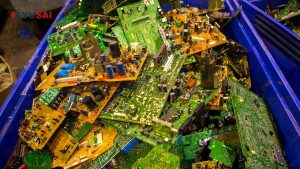
Electronic waste is one of the richest — and most complex — secondary sources of precious metals on earth. One ton of waste PCBs / motherboards typically contains 200–300 g of gold, roughly 50–80× the grade of high-grade gold ore, together with significant silver, palladium and copper. At the same time, these metals are dispersed and encapsulated: plating layers on connectors and edge fingers, bonding wires inside IC packages, solder alloys, and contact alloys — all embedded in a composite matrix of resin, glass fibre and copper foil. No single process is enough: mechanical enrichment and chemical refining must work in tandem.
Our Precious Metal Refining Plant integrates both in one engineered, turnkey line. The mechanical enrichment stage (dismantling → two-stage crushing to 1–5 mm → magnetic / eddy-current / air classification) liberates and concentrates the metal fraction from the resin/glass-fibre matrix; the non-cyanide hydrometallurgical stage (base-metal leaching → precious-metal leaching → solid-liquid separation → purification → reduction / electrowinning → melting & casting) then selectively recovers gold, silver, palladium and platinum at industrial purity — with no cyanide anywhere in the flowsheet and full fume scrubbing and wastewater treatment built in.
The line is delivered as five integrated modules:
- Physical separation module — dismantling, two-stage crushing, magnetic / eddy-current / air classification: liberates and concentrates the metal fraction
- Hydrometallurgical module — base-metal leaching, precious-metal leaching, solid-liquid separation, purification, reduction & electrowinning
- Refining & casting module — melting in induction furnaces, ingot casting, per-batch purity certification
- Environmental module — NOx/Cl₂ fume scrubbing, wastewater treatment, dust recycling: closed-loop and auditable
- Control module — PLC/DCS automation with full batch logging, online pH/ORP instrumentation
Core performance:
- Recovery rate: Au ≥ 98–99%, Ag ≥ 97%, Pd 88–96%, Pt 90–95%; system metal loss < 1% (full-process metal balance)
- Product purity: gold/silver up to 99.99% (4N); palladium/platinum up to 99.95%; cathode copper ≥ 99.95%
- Capacity: modular lines from 500 kg/day (pilot) to 10+ t/day (industrial) of e-waste; phased investment supported
- Final products: 1 kg / 5 kg / 12.5 kg ingots and custom formats, each batch verified by ICP-OES with a purity certificate
- Automation: PLC/DCS control, one-operator supervision, online pH/ORP instrumentation, full batch traceability and metal-balance ledger
- Environment: NOx/Cl₂ fume scrubbing, dioxin/furan control, closed-loop wastewater treatment and hazardous residue management to international standards
The plant is modular and scalable — from pilot scale (500 kg/day of e-waste) to industrial scale (10+ tons/day) — and can be configured as a dedicated line for PCBs, mobile phone boards, SIM cards, gold-plated scrap, anode slime, or a mixed multi-feedstock line. It is designed for e-waste recyclers, smelters, refinery operators and EPC projects that want an environmentally compliant, economically sound route from electronic scrap to high-purity metal. Manufacturing follows ISO 9001 and CE standards, and the supply package runs from free feedstock assay and process design through installation, operator training and lifetime after-sales support.
Recovery Value Analysis
1. Precious metal content of typical feedstocks
- Waste PCBs / motherboards — typical gold 200–300 g, 50–80× grade of high-grade ore; also Ag, Pd, Cu (≈130 kg Cu)
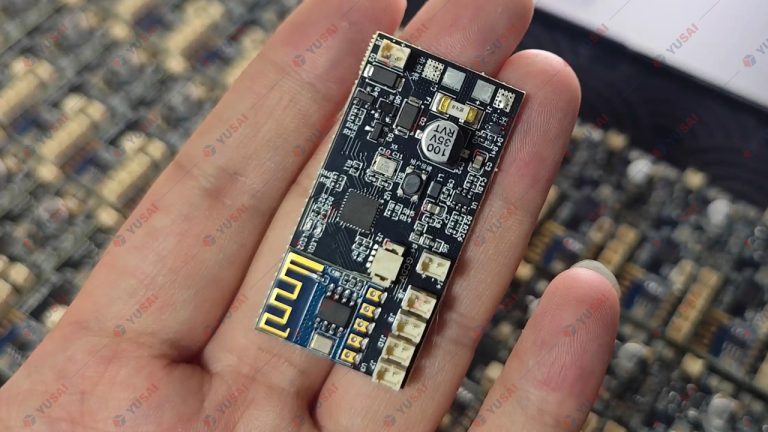
- Old-generation mobile phone boards — ≈200 g gold, 40–60× ore grade; also Ag, Pd, Cu
- SIM cards (reported values, verify by assay) — up to ≈1,000 g gold, extremely high grade; also Ag, Pd
- CPU / IC scrap (sorted) — highest gold per kg, very high grade; Au bonding wire, Ag
- Anode slime — 20–40% gold, highest-value intermediate; also Ag, Pd, Pt, Cu
Industry data, 2025–2026. Actual content varies by board type, age and manufacturer — every batch must be assayed before valuation.
2. Value calculation example
Using mid-August 2026 spot prices (Au ≈ USD 140–142/g, Ag ≈ USD 2.1/g, Pd ≈ USD 41–45/g):
- 1 ton of waste PCBs at 250 g/t gold → gold metal value alone ≈ USD 35,000 (USD 28,000–42,000 depending on grade), before adding silver, palladium and electrolytic copper.
- Copper (≈130 kg/t) and silver add a substantial second revenue stream that underpins plant economics.
Net profit = metal value − feedstock cost − reagents − energy − labour − hazardous waste disposal. We provide a free metal balance, payback period and ROI model based on your actual feedstock data.
3. Business models supported
- Toll refining: customer supplies material, plant charges a processing fee — no metal price exposure, stable cash flow.
- Buyout model: plant buys feedstock and sells refined product — higher margin, requires fast inventory turnover or hedging against price volatility.
4. Typical payback
For a mid-scale line (1–3 t/day e-waste) processing Grade A–B feedstock, typical payback is 12–24 months, depending on feedstock grade, purchase price and throughput. Our engineers will model your specific case free of charge.
Applicable Materials
Printed circuit boards
- Waste PCBs from computers, servers and telecom equipment
- Motherboards, daughterboards, expansion cards; bare and populated boards
- PCB manufacturing offcuts and rejects
Mobile & consumer electronics
- Mobile phone boards and handsets (batteries removed first)
- CPUs, RAM modules, SIM cards, IC chips and IC packaging scrap
- Laptops, tablets and their circuit boards
Gold-plated & precious-metal components
- Gold-plated connectors, edge fingers and terminals
- Plated scrap, rejected plating parts, gold-bearing ash and polishing dust
- Relays, switches and contacts (silver-bearing)
- MLCC / chip capacitors and other palladium–silver components
Other high-value streams
- Anode slime / anode mud(smelter intermediate)
- Precious-metal-bearing dust and sweeps from electronics manufacturing
- Battery circuit assemblies (after battery removal)
Feedstock grading guide
- Grade A (high value) — phone boards, CPUs, memory edge fingers, gold-plated connectors, SIM cards; value driver: high plating density; route: direct to hydrometallurgical stage
- Grade B (mid value) — computer motherboards, server/telecom boards; value driver: Au + Cu; route: full physical separation + base-metal leaching first
- Grade C (low value) — TV/appliance boards, power supply boards; value driver: Cu mainly, low PGM; route: bulk physical separation, copper circuit
Mixed or unusual materials? Send a sample — we characterize the material and design the right process route.
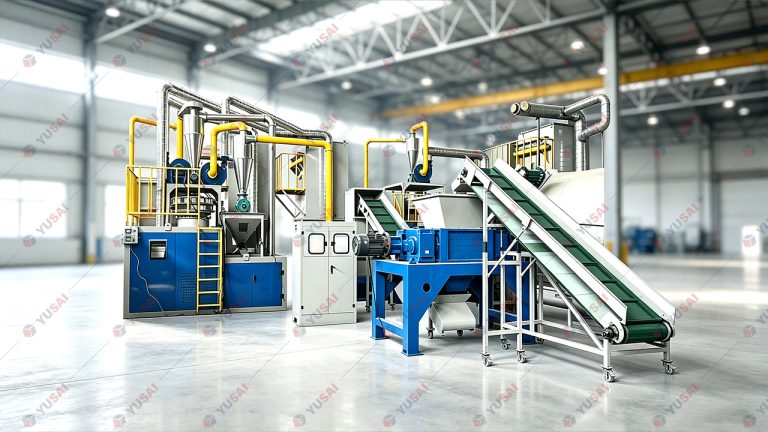
Product Structure (Main Equipment)
The plant is delivered as a complete line. Main equipment modules:
- PCB dismantling machine / component removal line — removes chips, ICs and valuable components before crushing
- Two-stage crusher (coarse + fine) — liberates metal from non-metal matrix; fine crush to 1–5 mm
- Vibrating screen & classifier — size control between crushing stages
- Magnetic separator — removes iron and steel
- Eddy-current separator — recovers aluminium and copper
- Air classifier + bag-house dust collector — separates resin/glass fibre/plastic; collects PM-bearing fines and returns them to the circuit
- Rotary kiln (roasting, optional) — removes organics, releases metals encapsulated in IC packages; 350–550 °C
- Off-gas treatment train (for roasting) — secondary combustion + rapid quench + caustic scrubbing + activated carbon (dioxin control)
- Leaching reactors (glass-lined / titanium, PP-lined tanks) — base-metal leaching and precious-metal leaching; steam-jacket or electric heating; ORP-controlled oxidant dosing
- Plate & frame / membrane filter press — solid-liquid separation; counter-current cake washing
- Solvent extraction mixer-settlers (multi-stage) — separates gold and palladium selectively (DBC / TBP / oxime extractants)
- Ion-exchange columns — polishes raffinate to ppm-level precious metal loss
- Electrowinning cells (gold / silver / copper) + rectifiers — cathode copper ≥ 99.95%; silver electrolytic refining
- Reduction & precipitation reactors — SO₂ / oxalic-acid gold reduction; cementation for silver
- Medium-frequency induction melting furnace + ingot molds — melting above 1,064 °C (Au), casting 1 / 5 / 12.5 kg ingots and custom formats
- NOx / Cl₂ fume scrubber — treats acid fumes to discharge standards
- Wastewater treatment system — neutralization, flocculation, precipitation, ion exchange, electrowinning recovery
- PLC/DCS control cabinet — full automation, batch logging, online pH/ORP instruments
Equipment configuration is customized per feedstock, capacity and local standards — final list is issued with the process design package.
Precious Metal Refining Plant Process Flow
Eight integrated stages. The whole line is controlled and logged by PLC/DCS for consistent, auditable results.
Stage 1. Dismantling & Sorting
Stage 2. Crushing & Physical Separation
Two-stage crushing (coarse 20–50 mm → fine 1–5 mm), then magnetic separation (iron/steel), eddy-current separation (Al/Cu), air classification (resin/glass fibre/plastic). Dust-collector fines contain precious metals — collected and returned to the metallurgical circuit, never discarded. Key parameter:fine-crush size 1–5 mm; metal recovery through separation ≥ 95%.
Stage 3. Roasting (Optional)
Rotary kiln at 350–550 °C removes residual organics and releases metals encapsulated in IC packages. Temperature control is critical: too hot sinters metal (impedes leaching); too cool leaves organics (consume oxidants). Off-gas passes through secondary combustion + quench + caustic scrubber + activated carbon to prevent dioxin/furan emissions.
Stage 4. Base-Metal Leaching (Copper Recovery)
Sulfuric acid + oxidant (or nitric acid) dissolves copper, nickel, iron and zinc, concentrating gold/silver/palladium in the solid residue several- to tens-fold. Copper is recovered from solution by electrowinning (cathode ≥ 99.95%) or cementation. Key parameters: L/S ratio 3:1–5:1; 60–80 °C; 2–6 h; Cu leaching rate ≥ 95%; NOx to scrubber.
Stage 5. Precious Metal Leaching
Selective dissolution of gold and palladium via aqua regia (HCl:HNO₃ ≈ 3:1, 60–95 °C) or controlled-potential chlorination (HCl + Cl₂/oxidant with real-time ORP control). Silver forms AgCl in chloride media and passivates gold — silver-rich feeds are routed through the nitric-acid circuit first. Key parameters: L/S 2:1–4:1; Au leaching rate ≥ 98%; negative-pressure ventilation with fume scrubbing.
Stage 6. Solid-Liquid Separation
Membrane / plate-and-frame filter presses produce clear PGM solution; filter cake undergoes 2–3 stages of counter-current washing to recover entrained solution. Control targets: cake moisture ≤ 30%; metal loss at this stage < 0.5% (verified by fire assay).
Stage 7. Purification & Separation
- De-contamination: residual Cu/Fe/Sn removed; oxidation state adjusted.
- Solvent extraction (SX): multi-stage counter-current mixer-settlers — DBC or TBP selectively extracts gold; oxime/amine extractants extract palladium; organic phase regenerated and recycled.
- Ion exchange: anion resins polish low-concentration solutions, cutting raffinate loss to below ppm level.
- Precipitation/cementation: for smaller batches (e.g. DMG precipitation of palladium, ammonium chloride precipitation of platinum).
Stage 8. Reduction, Electrowinning & Melting
- Gold reduced with SO₂ or oxalic acid (SnCl₂ “purple of Cassius” test confirms complete reduction); silver by electrolytic refining (Möbius process) or cementation.
- Gold/silver powder washed to neutral, vacuum-dried, melted in a medium-frequency induction furnace and cast into ingots.
- QC per ingot by ICP-OES; purity certificate issued with every shipment.
Product Features
- Non-cyanide hydrometallurgy — no cyanide anywhere in the process; short flowsheet, lower pollution load
- High recovery, high purity — Au recovery ≥ 98–99%, purity up to 99.99%; Ag ≥ 97%; Pd 88–96%; system metal loss < 1% (full metal balance)
- Multi-metal recovery in one line — gold, silver, palladium, platinum and copper; copper revenue underpins plant economics
- Selective separation capability — controlled-potential chlorination + multi-stage SX + IX handles complex mixed-composition feeds
- Eco-compliant engineering — NOx/Cl₂ scrubbing, dioxin control, wastewater treatment and hazardous residue management to international standards
- Inherently safe design — battery pre-removal, explosion-proof crushing, negative-pressure ventilation, gas alarms, emergency neutralization
- Fully automated & auditable — PLC/DCS control, one-operator supervision, full batch logging, metal-balance ledger ready for audit
- Modular & scalable — 500 kg/day pilot to 10+ t/day industrial lines; phased investment possible
- Anti-corrosion engineering — glass-lined / titanium reactors matched to each chemical service
- One-stop delivery — sample testing, process design, manufacture, installation, operator training, after-sales and process optimization
Technical Parameters
1. Plant models (e-waste processing capacity)
| Parameter | PMR-500 | PMR-1000 | PMR-3000 |
| E-waste capacity | 500 kg/day | 1 t/day | 3 t/day |
| Installed power | ~80 kW | ~150 kW | ~300 kW |
| Floor area (approx.) | 150 m² | 300 m² | 600 m² |
| Operators per shift | 2–3 | 3–4 | 4–6 |
| Control mode | PLC | PLC | PLC |
| Refining batch size (Au) | 10–50 kg | 20–100 kg | 50–200 kg |
Parameters are indicative; final values are confirmed with the process design package for your feedstock.
2. Refining performance
| Model | Recovery rate | Product purity |
| Gold (Au) | ≥ 98–99% | ≥ 99.95% |
| Silver (Ag) | ≥ 97% | ≥ 99.99% |
| Palladium (Pd) | 88–96% | ≥ 99.95% |
| Platinum (Pt) | 90–95% | ≥ 99.95% |
| Copper (Cu) | electrowon cathode | ≥ 99.95% |
| Total system metal loss | < 1% | — |
3. Utilities & environment
- Power: 380 V / 50 Hz 3-phase (220 V / 60 Hz and other configurations available)
- Cooling water, process water and compressed air per design package
- Wastewater: treated and recycled (closed loop); discharge meets local standards
- Off-gas: NOx / Cl₂ scrubbed to discharge standards; gas alarm + emergency systems included
Advantages
1. Process route comparison — why hydrometallurgy
- Mechanical separation only — recovery 60–85%; product: mixed metal powder (not pure metal); energy/emissions: low; verdict: cannot produce pure metal, fine PM lost in dust
- Pyrometallurgical smelting — recovery 90–95%; product: bullion, needs further refining; energy/emissions: high energy, dioxin & fume control costly, uneconomical at small scale; verdict: suits large centralized operations only
- Physical separation + hydrometallurgy (this system) — recovery: Au ≥ 98–99%, Ag ≥ 97%, Pd 88–96%; product: high-purity metal ≥ 99.9–99.99%; energy/emissions: short flowsheet, non-cyanide, scrubbed & treated; verdict: best economics for mid-size, multi-feedstock, high-value e-waste
2. Supplier advantages
- Free feedstock testing — fire assay / ICP-OES analysis of your material; composition report and recommended process route issued before you spend a dollar
- Custom process design — flowsheet, mass balance, metal balance, equipment list and plant layout tailored to your feedstock and site
- Turnkey delivery — one contract covers design, manufacture, FAT, installation, commissioning, training and after-sales
- Factory acceptance testing (FAT) — equipment tested in our factory with your material before shipment
- OEM / ODM capability — branding and configuration customization available
- Global track record — plants exported to clients across Asia, Africa, Europe, the Middle East and the Americas; customer visit and reference plants welcome
- 24/7 engineering support — spare parts at cost price, remote diagnosis, lifetime technical consultation
Quality System
Professional precious-metal refining is built on auditability as much as chemistry.
- Incoming assay — handheld XRF rapid grading → sample preparation by riffling/splitting → fire assay (cupellation) + ICP-OES arbitration for definitive valuation
- In-process monitoring — sampling at every stage (leach liquor, filter cake, wash liquor, raffinate, wastewater); online temperature, pH and ORP at critical points
- Product verification — ICP-OES cross-checked with fire assay; purity certificate issued per batch
- Metal balance ledger — every batch tracked as Input = Output + In-process + Loss; reconciled monthly; loss rate > 1% triggers immediate investigation
- Loss investigation path — residue carry-over → washing efficiency → raffinate loss → dust-collector fines → wastewater entrainment → weighing/assay error
- Manufacturing quality — ISO 9001 quality management, CE-marked electrical system, pressure/vacuum-tested reactors, corrosion-tested piping, FAT with your material before shipment
- Documentation — full technical file: drawings, P&ID, operating manual (SOP), safety manual, spare-parts list, test certificates
Service Process
- Requirements scoping — feedstock type, daily throughput, target products, local regulatory requirements
- Sample testing — free fire assay / ICP analysis; composition report issued
- Process design — flowsheet, mass balance, metal balance, equipment list, plant layout
- Proposal & quotation — technical proposal + CAPEX estimate + ROI projection (within 5 working days)
- Contract & manufacturing — fabrication, quality inspection, factory acceptance testing (FAT)
- Installation & commissioning — on-site installation supervision, interlock testing, feed commissioning
- Operator training — process, equipment, safety and assay training; operating manual (SOP) handed over
- After-sales support — spare parts supply, remote technical support, process optimization and capacity expansion
Warranty & After-Sales
- Warranty: 12 months against manufacturing defects from the date of commissioning (extended 24-month warranty available on request)
- Spare parts: original spare parts supplied at cost price for the life of the plant; recommended spare-parts kit included with shipment
- Remote support: 24/7 online technical consultation; response within 24 hours
- On-site service: engineers dispatched to site within 72 hours (visa permitting) for major issues
- Training: initial operator training included; refresher and advanced assay training available
- Optimization: annual process review, reagent/parameter optimization, and capacity-expansion guidance for your growing feedstock volumes
Cautions & Safety Notes
Feedstock & valuation
- Grade and value all material by XRF screening + fire assay / ICP arbitration — never by visual estimation
- New-generation smartphones carry less gold (thinner plating); always assay before pricing
- E-waste is classified as hazardous waste in most jurisdictions — verify supplier licences and maintain a traceability ledger
Process operation
- Remove batteries before any crushing — lithium batteries are a fire and explosion hazard
- Route silver-rich feeds through the nitric-acid circuit first — AgCl passivation in chloride media encapsulates gold and suppresses leaching
- Roasting temperature must be precisely controlled (sintering vs. incomplete organic removal both hurt downstream performance)
- Prepare aqua regia fresh; add acid slowly with temperature control to prevent boil-over; route NOx fumes to the scrubber
- Counter-current cake washing is mandatory; assay cake and filtrate separately
- Dust-collector fines contain precious metals — collect and return to the circuit, never discard or vent
Safety & compliance
- NOx and Cl₂ fumes scrubbed to discharge standards; gas alarms and emergency showers installed
- Manage chemicals per SDS; hydrazine and hydrogen (where used) handled as hazardous chemicals
- Hazardous residues, effluents and spent activated carbon handled under a hazardous-waste operating licence; complete environmental assessment and permits before commissioning
Business management
- Metal balance ledger: sample and assay every batch, monthly reconciliation, investigate any loss > 1%
- High-value asset security: vault, CCTV, dual-person dual-lock, in/out registration
- For buyout models, hedge metal price risk or maintain fast inventory turnover
FAQ
Q1: How much gold is in e-waste?
One ton of waste PCBs / motherboards typically contains 200–300 g of gold — 50–80× the grade of high-grade ore — plus silver, palladium and copper. Content varies widely by board type and age; we assay every batch before valuation.
Q2: What materials can your plant process?
Waste PCBs, mobile phone boards, CPUs, RAM modules, SIM cards, gold-plated connectors, MLCC capacitors, anode slime and other electronic scrap. Send a sample for free laboratory testing.
Q3: What metals do you recover, and at what rates?
Gold (recovery ≥ 98–99%, purity up to 99.99%), silver (≥ 97%), palladium (88–96%), platinum (90–95%) and electrolytic copper (≥ 99.95%). Tin and nickel can also be recovered where present.
Q4: Is the full process from e-waste to refined metal included?
Yes. The plant covers dismantling, crushing, physical separation, roasting (optional), base-metal leaching, precious-metal leaching, purification, reduction/electrowinning and melting — e-waste in, high-purity ingots out.
Q5: What is the minimum capacity, and what is the payback period?
Pilot lines start at 500 kg/day of e-waste; industrial lines handle 10+ tons/day. Typical payback for a mid-scale line is 12–24 months depending on feedstock grade, purchase price and throughput — provide your data and we will model it free of charge.
Q6: Is the process environmentally compliant?
Yes. Non-cyanide hydrometallurgy, NOx/Cl₂ fume scrubbing, dioxin control, wastewater treatment and hazardous-waste management are engineered to international standards. We also advise on the local permits required.
Q7: Why use hydrometallurgy rather than smelting?
Smelting suits large centralized operations but is energy-intensive, generates dioxins, incurs high fume-control costs, is uneconomical at small scale and loses more precious metal to slag and fume. Hydrometallurgy delivers higher recovery and purity with lower emissions, and is more economical for mid-size, multi-feedstock, high-value e-waste.
Q8: Why must silver be processed separately?
In aqua regia and chloride leach media, silver immediately precipitates as AgCl. This AgCl layer passivates and encapsulates gold particles, suppressing gold leaching. Silver-rich feeds are therefore pre-treated in the nitric-acid circuit first, or AgCl is recovered separately from the leach residue.
Q9: Do you provide installation and training?
Yes. Turnkey delivery includes on-site installation supervision, commissioning and full operator training (process, equipment, safety and assay), with an operating manual (SOP) handed over.
Q10: Can I get a sample test before purchasing?
Yes. Send us 100–500 g of representative feedstock — we run free fire assay / ICP-OES analysis and issue a composition report with a recommended process route, no obligation.

Get A Free Quote
If you have any requirement or suggestion, please fill in the form and send it to us, We look forward to building a long-term partnership with you.
- +86 18339216321
- info@yusaipreciousmetals.com
- Zhengzhou.Henan.China
If you be interested in our equipment and solutions, please to contact us.
- +86 18339216321
- info@yusaipreciousmetals.com
- zhengzhou.henan.china