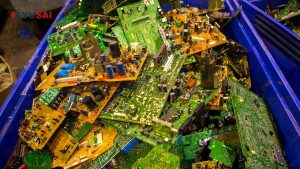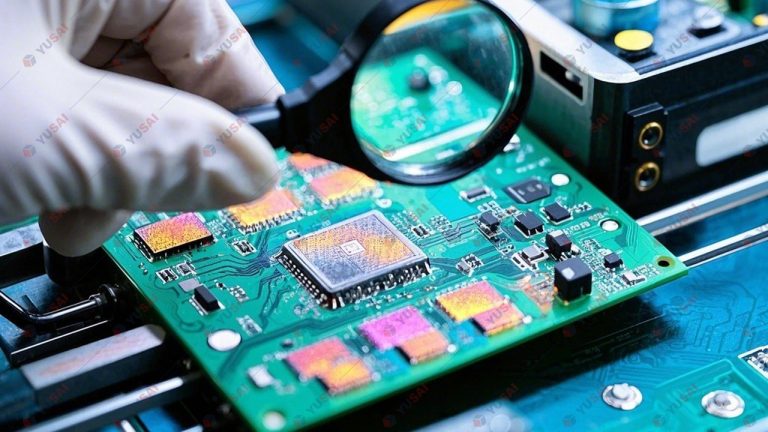
Waste printed circuit boards (WPCBs) are core components of obsolete electrical and electronic equipment. Rapid electronics replacement generates massive volumes of e-waste each year. Direct disposal of discarded PCBs releases heavy metals and polymer resin into soil and water, causing severe ecological contamination, while valuable metallic resources are wasted without recovery.
Three mainstream technologies are used for PCB metal recycling: pyrometallurgy, hydrometallurgy and bioleaching.
- Pyrometallurgy: Incinerates and smelts scrap PCBs to burn off resin. However, it produces highly toxic flue gas containing dioxins, furans and PCBs, with large safety risks and secondary pollution.
- Bioleaching: Uses microbial metabolism to dissolve target metals. Its operating cost is low, but microbial cultivation is expensive, reaction cycles are long, and industrial scaling remains immature.
- Conventional hydrometallurgy: Often uses nitric acid as oxidant. It releases nitrogen oxides (NOₓ) and generates large volumes of heavy-metal wastewater. In addition, strong oxidants degrade copper extractants, and high acidity of leach liquor inhibits solvent extraction and reduces cathode copper purity.
This article introduces an improved hydrometallurgical route using sodium chlorate and sulfuric acid leaching, followed by five-stage solvent extraction, two-stage stripping and electrowinning. The process avoids NOₓ emission, protects organic extractants, and produces 99.99% high-purity cathode copper. It enables harmless treatment and circular reuse of waste printed circuit boards.
Process Principle
The whole workflow includes mechanical pre-concentration, oxidative leaching, solid-liquid separation, solvent extraction & stripping, and copper electrowinning.
1. Mechanical Pre-Concentration
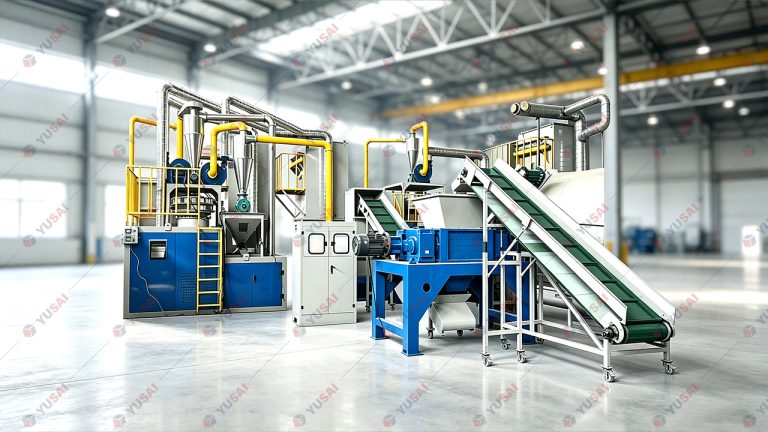
Dismantled PCBs (without electronic components) are crushed into chunks, pulverized and sieved through a 30-mesh screen. Air classification separates metallic particles from non-metallic powder. Electrostatic separation further removes part of iron, yielding a copper-rich metal concentrate.
2. Oxidative Leaching (Sodium Chlorate – Sulfuric Acid System)
Sodium chlorate acts as oxidant in dilute sulfuric acid medium to oxidize elemental copper into soluble copper sulfate. Reaction equation:
\(\boldsymbol{NaClO_3 + 3H_2SO_4 + 3Cu = 3CuSO_4 + NaCl + 3H_2O}\)
Operating window:
- NaClO₃: 0.05 ~ 0.5 mol/L
- H₂SO₄: 0.1 ~ 5 mol/L
- Temperature: 20–80 °C; stirring speed: 500 rpm; leaching time: 0.5–3.0 h
- Solid-liquid ratio: 100 g metal concentrate : 2.5 L leaching solution
- Reactor: Titanium or ceramic reactor (acid & corrosion resistant)
This leaching system eliminates nitric acid, so no NOₓ gas is generated. Acid consumption during reaction keeps leachate pH above 1.2, which matches the pH requirement for copper solvent extraction. Residual strong oxidant in the pregnant leach solution (PLS) is negligible, preventing oxidative damage to organic extractants. Copper leaching rate reaches nearly 100%.
3. Solid-Liquid Separation
Leach slurry is filtered by plate-and-frame filter press or centrifugation to remove solid residues, obtaining clear copper pregnant leach solution (PLS).
4. Purification via 5-Stage Solvent Extraction & 2-Stage Stripping
Selective solvent extraction separates copper from impurities such as iron, aluminium, lead and zinc. Extractant formulation: LIX984, N910 or DZ973N mixed with 26# kerosene. Volume ratio: extractant 10–30%, kerosene 70–90%.
Extraction reaction:
\(\boldsymbol{2RH_{(org)} + Cu^{2+}_{(aq)} = CuR_{2(org)} + 2H^+_{(aq)}}\) RH = organic extractant; CuR₂ = copper organic complex
Five counter-current extraction stages transfer Cu²⁺ selectively into organic phase, forming copper-loaded organic. The raffinate after extraction returns to the leaching tank for reuse.
Loaded organic then undergoes two-stage stripping using sulfuric acid stripping solution (1–5 mol/L H₂SO₄). Stripping reaction:
\(\boldsymbol{CuR_{2(org)} + 2H^+_{(aq)} = 2RH_{(org)} + Cu^{2+}_{(aq)}}\)
Stripping releases copper ions back into aqueous phase to produce high-concentration copper electrolyte (rich copper solution, ~40 g/L Cu). The stripped organic phase passes three-stage acid washing and recycles back for extraction. Iron and other impurity metals are largely rejected, keeping impurity concentration below 2 g/L.
5. Electrowinning for High-Purity Copper
The rich copper solution is fed into electrowinning cell. PVC balls (2–5 mm diameter, layer thickness 2–5 mm) float on electrolyte surface to suppress irritant gas release.
- Cathode: titanium plate, stainless steel or pure copper plate
- Anode: lead-calcium-tin alloy plate
- Operating parameters: cell voltage 1.5–4.5 V, electrode spacing 2–16 cm, current density 50–700 A/m², temperature 20–60 °C, electrowinning duration 0.5–10 h
Electrode reactions: Cathode (copper deposition):
\(\boldsymbol{Cu^{2+}+2e^- = Cu}\) Anode (oxygen evolution):
\(\boldsymbol{4OH^- = O_2 + 2H_2O + 4e^-}\)
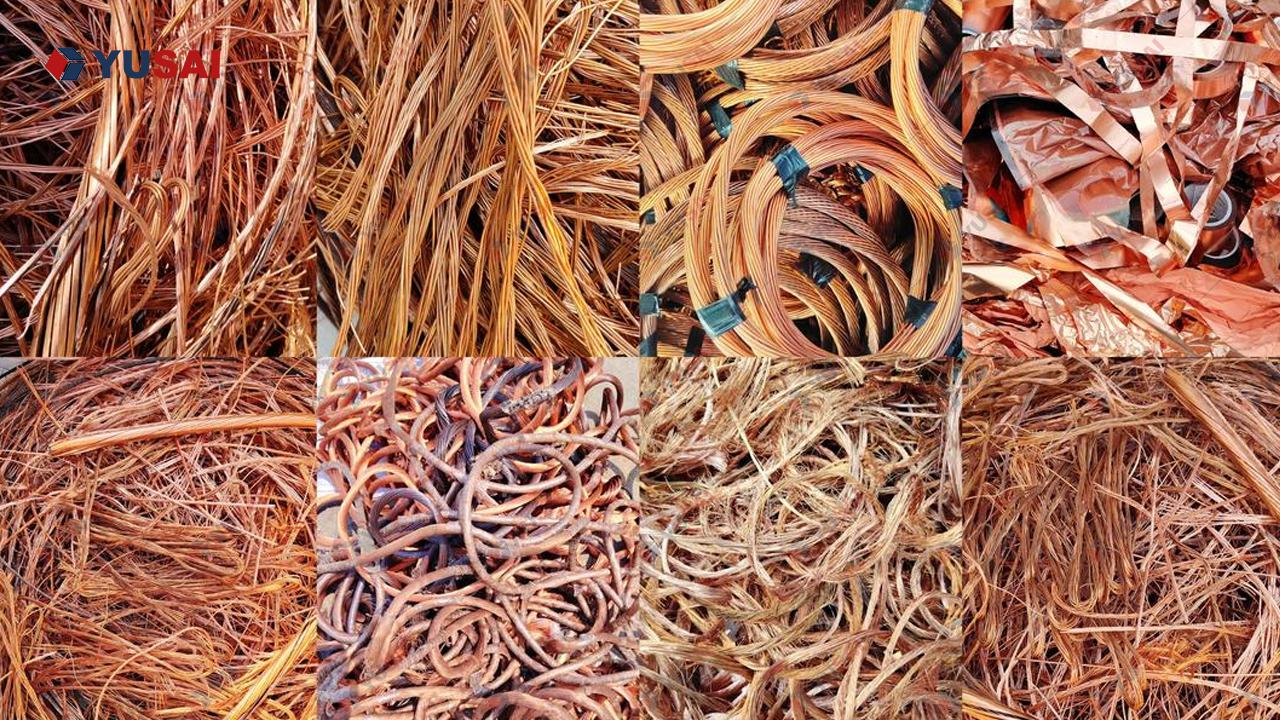
Copper deposits uniformly on cathode plate. After harvesting, cathode copper purity ≥99.99%. The depleted electrolyte after electrowinning can be recycled as stripping liquor.
Key Advantages of This Technology
- Environmentally friendly: No nitric acid, zero NOₓ emission. Low residual oxidant protects extractant from degradation.
- High copper recovery & purity: Full copper leaching; multi-stage extraction-stripping removes iron and heavy metal impurities. Final cathode copper reaches 99.99%.
- Full liquid & organic phase recycling: Extraction raffinate returns to leaching; stripped organic and spent electrolyte are reused, lowering chemical consumption and wastewater discharge.
- Mild operating conditions: Near ambient pressure, moderate temperature, simple equipment and easy operation.
- Economic benefit: Combines physical beneficiation and hydrometallurgy, suitable for scaled e-waste PCB recycling, realizing waste reduction, resource recovery and harmless disposal.
Typical Operating Examples
The metal concentrate used in all test cases contains 75 wt% Cu, 7.5% Fe, 2.1% Al, 2.7% Pb, 0.7% Zn, 0.1% Mn, and trace Ag/Au/Ni below 0.1%.
Example 1
- Leachant: 0.05 mol/L NaClO₃ + 0.1 mol/L H₂SO₄, 60 °C, 3 h leaching
- Extractant: DZ973N : 26# kerosene = 30 : 70 vol%
- Stripping liquor: 1 mol/L sulfuric acid
- Electrowinning: 4.5 V, 50 A/m², 20 °C, 0.5 h
- Result: Cathode copper purity 99.99%
Example 2
- Leachant: 0.5 mol/L NaClO₃ + 5 mol/L H₂SO₄, 60 °C, 0.5 h
- Extractant: DZ973N : 26# kerosene =10 :90 vol%
- Stripping liquor:5 mol/L sulfuric acid
- Electrowinning:1.5 V,700 A/m²,60 °C,10 h
- Result: Cathode copper purity 99.99%
Other trials using LIX984 or N910 extractants under medium conditions (2 mol/L sulfuric acid, 350 A/m² current density, 5 h electrowinning) also consistently produce 99.99% copper.
Conclusion
This integrated process combines physical separation, sodium chlorate-sulfuric acid oxidative leaching, multi-stage solvent extraction and electrowinning to recover ultra-high purity copper from waste printed circuit boards. It solves the common pain points of traditional hydrometallurgy: NOₓ pollution, extractant oxidation failure, high feed acidity limiting extraction, and impurity contamination lowering copper grade.
With recyclable reagents, low toxic emissions and stable copper purity, this hydrometallurgical route offers a practical and sustainable solution for e-waste PCB recycling, supporting circular economy in electronic scrap resource recovery.