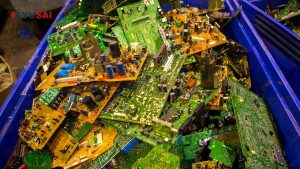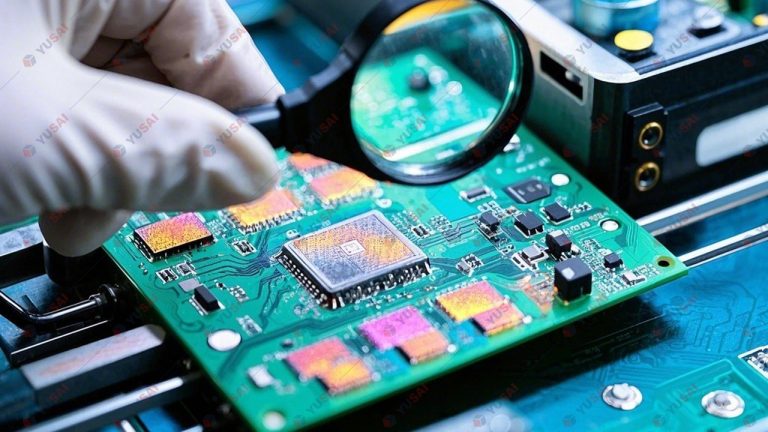
Electronic waste (e‑waste / WEEE) is one of the fastest‑growing waste streams across the globe. Driven by rapid innovation and short product‑update cycles, massive volumes of discarded computers, circuit boards, consumer electronics and communication devices are produced every year. Such waste carries severe environmental risks when dumped or landfilled, yet it is also a valuable “urban mine” loaded with recyclable metals, precious elements and engineering plastics. One tonne of mixed printed‑circuit‑board scrap can contain hundreds of kilograms of copper, plastic, iron, plus gold, silver, palladium and rare‑earth metals, bringing both environmental protection value and considerable economic benefits for proper recycling operators.
Our company focuses on e‑waste resource recovery solutions, covering technical consultation, process solution supply and international trade of recycled feedstock. Below is an overview of mainstream industrial recycling technologies for global partners’ reference.
Mechanical Pre‑processing Technology
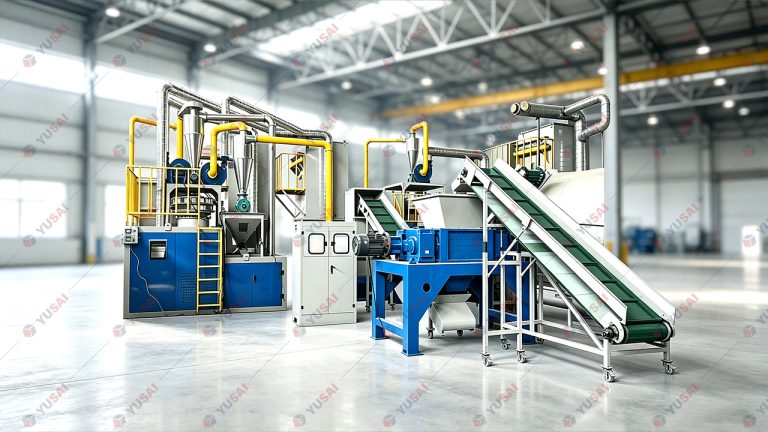
Mechanical treatment works as the essential front‑end procedure for almost all e‑waste recycling lines. It separates different components relying on physical differences including density, magnetism, electrical conductivity and particle shape, without heavy chemical consumption.
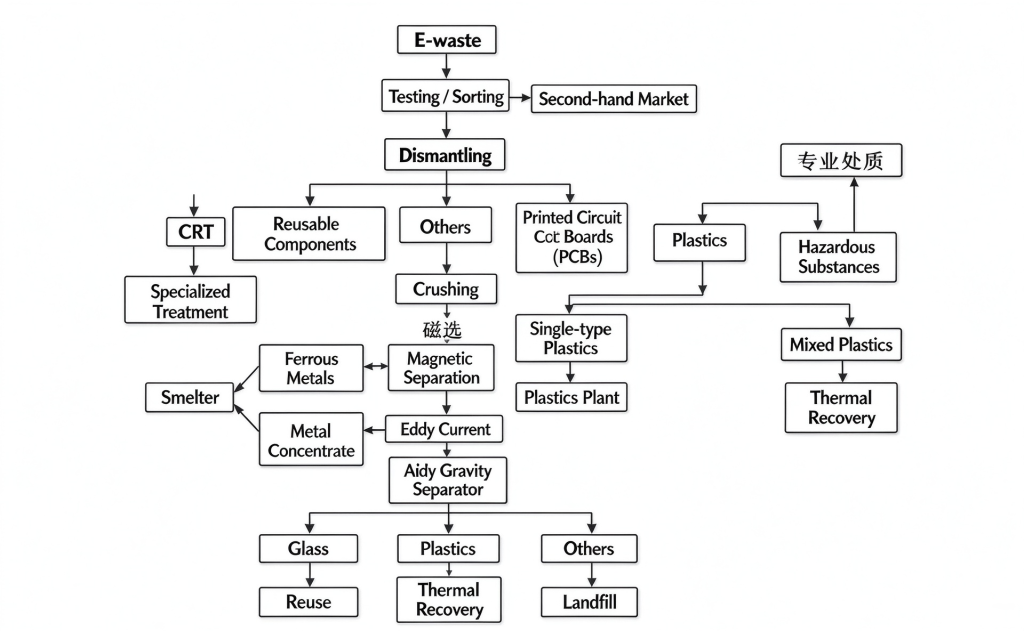
Key steps include disassembly, crushing and multi‑way sorting.
- Disassembly: Hazardous components such as batteries, capacitors and mercury‑bearing parts are manually or automatically detached in advance to avoid cross‑contamination in downstream workflows. Automated thermal‑release devices are widely adopted for large‑scale production to strip electronic components off waste PCBs efficiently.
- Crushing & milling: Targeted crushing equipment (shear crushers, impact mills, supersonic pulverizers) breaks composite circuit‑board materials, liberating metal granules from resin‑glass substrates to realize monomer dissociation, which lays the foundation for high‑efficiency sorting.
- Multi‑mode sorting:
- Magnetic separation removes ferrous iron‑rich fractions.
- Eddy‑current separation separates non‑ferrous conductive metals such as aluminium from insulating plastic and resin.
- Air density separation and electrostatic / triboelectric sorting further divide mixed plastics, copper fragments and residual precious‑metal‑bearing particles.
Mechanical processing features low secondary pollution, easy scale‑up and low operating cost. Its output is enriched material fractions, which will be sent to metallurgical units for further metal extraction or plastic re‑modification.
Pyrometallurgical Recovery
Pyrometallurgy adopts high‑temperature treatment including smelting, incineration and thermal decomposition to burn off plastic and organic binders, melting base metals and precious metals into alloy phases for subsequent purification. It can handle complicated mixed e‑waste feedstock and achieves high recovery rates for gold, silver, palladium and copper.
However, traditional pyrometallurgy has obvious drawbacks. Burning organics may release toxic flue gas; considerable metal value may be lost inside slag; large‑volume non‑metallic components are consumed during thermal processing. Modern industrial facilities must equip complete flue‑gas purification systems to meet international environmental standards.
Hydrometallurgical Recovery
Hydrometallurgy is currently the dominant route for precious‑metal extraction from e‑waste. Pre‑crushed material is leached with acid‑based chemical reagents to dissolve target metals into liquid phase. Valuable metals are later separated and purified via precipitation, solvent extraction or electrowinning to obtain pure metallic products.
Compared with pyrometallurgy, hydrometallurgy generates far less exhaust gas, delivers high‑purity metal output and stable precious‑metal recovery performance. Typical leaching systems include aqua regia, nitric‑acid‑based lixiviant and chloride leaching agents. Its main challenges lie in large chemical‑reagent consumption and heavy wastewater output, requiring systematic wastewater treatment before discharge.
Bio‑leaching (Microbial Metallurgy) & Emerging Processes
Bio‑leaching uses selected microbial strains to dissolve precious metals from e‑waste scraps. This cutting‑edge technology brings low reagent cost, low environmental hazard and competitive recovery efficiency even for low‑grade material, with reported precious‑metal recovery ratio up to 99% in lab and pilot tests. Constraints are long reaction cycles and strict temperature‑environment requirements, so further industrial optimization is ongoing for mass‑production adoption.
Microwave processing represents another innovative alternative. After PCB scraps are pulverized, microwave heating decomposes organic substances; high‑temperature melting afterwards separates metallic beads from glass‑phase residues, and the residual glassy material can be reused as construction raw materials.
Non‑metallic (Plastic) Recycling
Large quantities of ABS, HIPS and PC/ABS engineering plastics are contained in waste electronics. Large‑size pure plastic parts can be directly mechanically re‑granulated. Mixed plastic fractions adopt mechanical sorting, chemical depolymerization or thermal‑energy recovery pathways. Thermal recovery has been widely applied in European countries to gain heat or power from non‑recyclable plastic fractions under controlled emission conditions.
Our Value for Global Partners
E‑waste recycling is a core pillar of the circular economy. Realizing high‑value transformation of waste electronics demands balanced performance among recovery efficiency, product purity and environmental compliance.
We connect international suppliers, recyclers and downstream smelter & plastic‑reprocessing buyers worldwide. We provide:
- Professional technical briefings for e‑waste processing projects
- Quality grading and trading service for recycled PCB scraps, metal‑rich fractions and recyclable plastic feedstock
- Supply‑chain consultation to meet international environmental & shipment compliance requirements
If you are searching for reliable e‑waste‑related material suppliers or looking for feasible recycling‑process references, welcome to contact our team for detailed cooperation discussion.