Data note: The figures in this article are compiled from the Baidu Baike entry “E-waste”, the Global E-waste Monitor report, and the public text of China’s Regulations on the Administration of the Recovery and Disposal of Waste Electrical and Electronic Products, retrieved in August 2026.
1. A Staggering Number We Are Producing
According to the Global E-waste Monitor released by UN agencies in March 2024, the world generated about 62 million metric tons of e-waste in 2022, and less than a quarter of it was recycled. The report projects that, at the current pace, this will grow by 33% to 82 million metric tons by 2030, while the global recycling rate will actually drop to 20%.
China faces the same challenge. A 2010 UN Environment Programme report already ranked China as the world’s second-largest e-waste generator, producing over 2.3 million metric tons a year, behind only the United States at 3 million tons. By 2026, industry estimates put China’s stockpile of idle used smartphones at 6 billion units, with a hidden value of more than RMB 600 billion—yet only about 10% is recycled through formal channels.
On one side, discarded appliances pile ever higher; on the other, metal resources grow scarcer. This is why e-waste recycling technology has become a hot topic: it is both an environmental issue and an underestimated mine.
2. What Is E-Waste? Two Broad Categories
Electronic waste, also known as e-waste, refers to all discarded electronic equipment. It can be roughly divided into two categories based on material complexity and hazard level:
- Simple category: refrigerators, washing machines, air conditioners, and other household appliances, plus medical and scientific instruments. Materials are relatively simple and dismantling is easier.
- Complex category: computers, mobile phones, televisions, and the like. Cathode ray tubes contain lead; components contain arsenic, mercury, cadmium, and other hazardous substances. Processing requires far more sophisticated technology.
A single computer contains more than 700 components, about half of which contain toxic chemicals such as mercury, arsenic, or chromium. This is why e-waste cannot simply be landfilled or incinerated like ordinary trash—it must go through professional recycling routes.
3. Why Is It Called an “Urban Mine”?
The metals contained in e-waste—especially precious metals—have grades dozens or even hundreds of times higher than natural ore deposits, and the cost of recovery is generally lower than mining. The numbers are striking:
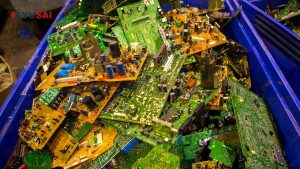
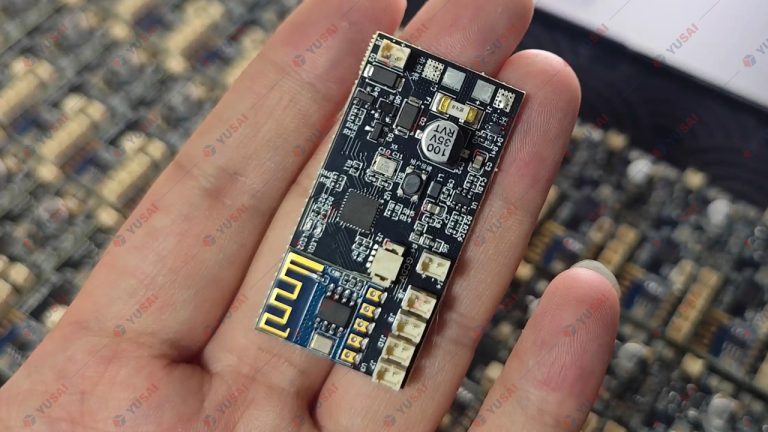
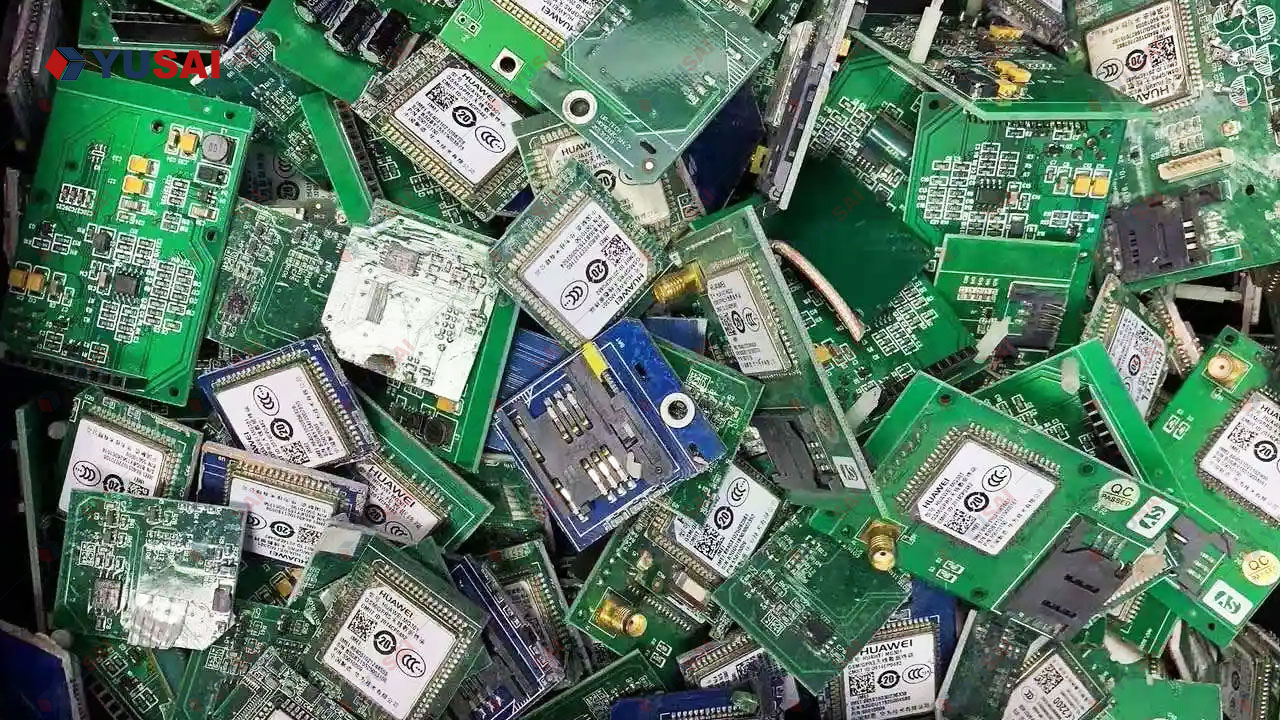
- One metric ton of randomly collected circuit boards can yield 143 kg of copper, 0.5 kg of gold, 40.8 kg of iron, 29.5 kg of lead, 2 kg of tin, 18.1 kg of nickel, and 10 kg of antimony;
- Each ton of waste circuit boards can contain around 1,000 grams of gold; as processes have improved, about 300 grams of gold (roughly RMB 30,000 at market prices) can now be extracted per ton;
- Japan’s Yokohama Metal Company found that every 100 grams of a scrapped phone body contains 14 grams of copper, 0.19 grams of silver, 0.03 grams of gold, and 0.01 grams of palladium, with lithium also recoverable from the phone’s lithium battery.
Beyond precious metals, the recyclable resources include iron, steel, and aluminum from housings, glass from cathode ray tubes, copper from deflection yokes, high-precision aluminum and copper from air-conditioner condensers and evaporators, and aluminum alloy from hard disk platters. Using recycled steel instead of freshly smelted steel can reduce mining waste by 97%, air pollution by 86%, and water pollution by 76%, while saving 90% of raw materials and 74% of energy.
4. The Price of Improper Disposal: The Guiyu Lesson
The town of Guiyu in Guangdong Province is the most notorious case of what happens when e-waste is handled badly. From March 2005, Greenpeace collected 44 environmental samples in and around the town. The tests showed that barium in the soil exceeded standards by more than 10 times, tin by 152 times, lead by 212 times, and chromium by as much as 1,338 times, while pollutants in water exceeded drinking-water standards by thousands of times. Medical checks on migrant workers in the area found that 88% of those surveyed suffered from skin, neurological, respiratory, or digestive diseases.
The reason lies in the crude methods used by unlicensed workshops: open-air burning and acid soaking to extract precious metals. Burning wires to recover copper releases highly toxic substances such as dioxins and furans; acid wastewater is discharged untreated, letting heavy metals seep into soil and groundwater. Mercury is converted by microorganisms into methylmercury, which accumulates up the food chain and severely damages the nervous system, while freon from abandoned refrigeration equipment destroys the ozone layer.
This is precisely why formal recycling technology matters: it turns recycling from a source of pollution into an entry point for resources.
5. Four Mainstream Processing Technologies
E-waste treatment and disposal today mainly follows four technical routes, each with its own trade-offs.
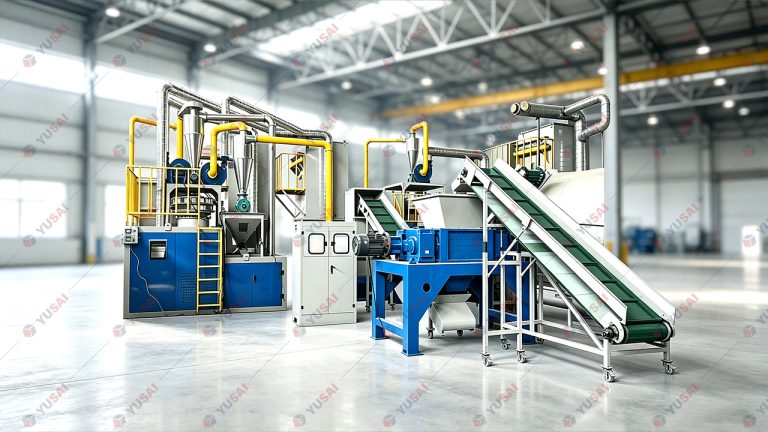
Mechanical processing exploits differences in the physical properties of components and recovers metals, plastics, and glass through dismantling, crushing, and sorting. Its strengths are low cost, simple operation, low risk of secondary pollution, and easy scaling, which is why it has become a development hotspot in many countries. Its weakness is that the large number and complex interconnections of electronic components make manual dismantling inefficient.
Chemical processing, also called hydrometallurgy, puts crushed particles into acidic or alkaline solutions for leaching, then uses extraction, precipitation, cementation, ion exchange, filtration, and distillation to obtain high-purity metals. It offers high recovery rates and purity, but requires strong acids and highly toxic fluorides and generates large volumes of waste liquid and toxic off-gas.
Pyrometallurgical processing enriches metals by incineration, smelting, sintering, and melting, which removes plastics and other organic components. It handles large volumes and is highly adaptable, but it emits hazardous gases such as dioxins and causes serious environmental damage.
Microbial processing (bioleaching) uses microorganisms—such as Acidithiobacillus ferrooxidans—to oxidize non-precious metals so that the precious metals are exposed for recovery. It is simple, low-cost, and easy to operate, but the leaching time is long. This technology has been studied since the 1980s for extracting precious metals from low-grade materials.
Mechanical processing is the hotspot of international development. To solve the low efficiency of manual dismantling, Japan’s NEC developed an automated dismantling system that uses infrared heating plus two-stage removal (vertical and horizontal impact forces) to detach through-hole and surface-mount components without damaging them. Germany’s FAPS company works in reverse to the assembly process: waste boards are placed in a heated liquid to melt the solder, and a SCARA robot then sorts usable components by shape.
In microbial processing, experiments using Acidithiobacillus ferrooxidans on pre-crushed e-waste fragments have leached more than 90% of copper, zinc, and nickel under selected temperature, pH, and dosage conditions, with lead stabilized as lead sulfate in the residue—combining resource recovery with stabilization.
6. China: From Unregulated Growth to Institutionalized Management
China’s e-waste recycling has undergone a clear transition:
- In 2000, the former State Environmental Protection Administration and the General Administration of Customs jointly issued a notice banning the import of eleven categories of waste electrical goods, including waste televisions and cathode ray tubes, waste computers, waste monitors and display tubes, waste copiers, waste camcorders, and waste household telephones;
- From January 1, 2011, the Regulations on the Administration of the Recovery and Disposal of Waste Electrical and Electronic Products took effect, establishing a multi-channel collection and centralized disposal system, a licensing system for disposal qualification, and an e-waste disposal fund. Producers of electrical and electronic products pay into the fund, which subsidizes recovery and disposal—in effect, a Chinese version of extended producer responsibility;
- Anyone engaged in e-waste disposal without a license faces shutdown, confiscation of illegal gains, and fines of RMB 50,000 to 500,000;
- In 2016, eight ministries issued the Measures for the Administration of the Restriction of Hazardous Substances in Electrical and Electronic Products, limiting lead, mercury, cadmium, hexavalent chromium, and other hazardous substances at the source. The same year, the Green Manufacturing Engineering Implementation Guide (2016–2020) called for whole-product dismantling and multi-component resource utilization of waste electrical and electronic products, and for substantive progress on extended producer responsibility by 2020.
Internationally, France follows the principle that “whoever produces, sells, or uses the product bears the related environmental costs”; Germany applies “the polluter pays,” with manufacturers bearing primary responsibility; and Japan’s Household Appliances Recycling Law, in force since April 1, 2001, obliges manufacturers to take back and recycle used appliances. All these experiences point in one direction: internalizing the cost and responsibility of recycling into the product’s full life cycle.
7. The New Frontier: Rare Earths in E-Waste
The value boundary of e-waste recycling is expanding. In July 2025, seeking to reduce its dependence on Chinese rare earths, the U.S. Department of Defense spent $400 million to become the largest shareholder of MP Materials, America’s biggest rare-earth producer—and it also set its sights on e-waste. U.S. recyclers are increasingly extracting neodymium, praseodymium, terbium, and dysprosium from discarded electronics. E-waste is thus becoming not only a “precious metals mine” but also a “rare-earth mine” in the competition for strategic resources among major powers.
Conclusion
E-waste is a resource in the wrong place. The UN report notes that if countries could raise the e-waste recycling rate to 60% by 2030, it would generate more than $38 billion in economic benefits from reduced health risks alone. For individuals, handing old phones and appliances to formal recycling channels is a way to join this “urban mining”; for industry, the maturing of mechanical separation, bioleaching, and rare-earth recovery is making the value chain both green and profitable. The difference between waste and a mine lies only in whether we have the right technology.