Data note: The technical details in this article are compiled from the Baidu Baike entry “E-waste” (电子废弃物) and the Regulations on the Administration of the Recovery and Disposal of Waste Electrical and Electronic Products, retrieved in August 2026.
1. Three Stages of Technological Evolution
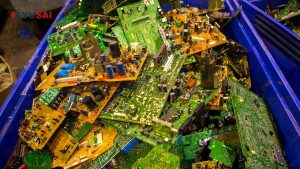
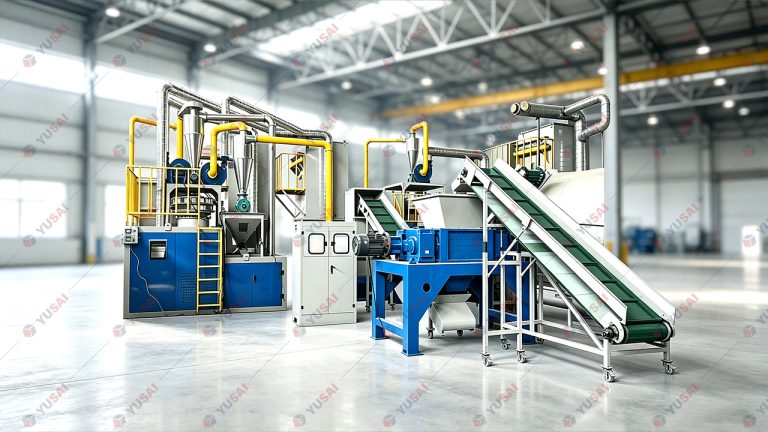
E-waste recycling technology has not stood still. Before the 1970s, the recovery of waste circuit boards focused almost exclusively on precious metals. Since then, as the demand for resource reuse has grown, the field has expanded to the comprehensive recovery of ferromagnetic materials, non-ferrous metals, precious metals, and organic substances. Today, a mature e-waste processing line typically consists of four stages: dismantling → crushing → sorting → metallurgical refining. Different technologies are applied at each stage, ultimately breaking a discarded device down into renewable raw materials such as copper, aluminum, iron, gold, silver, palladium, plastics, and glass.
2. Stage One: Dismantling—From Manual Labor to Automation
Dismantling is the first step in e-waste processing. Its purpose is to recover reusable electronic components (after testing) and to separate different materials.
- Manual dismantling remains the mainstream method because it flexibly adapts to complex products. However, the sheer number of components and their complex interconnections make it inefficient, and workers face health risks from direct contact with lead-based solder and mercury-containing parts.
- Automated dismantling: Japan’s NEC has developed an automated system for removing components from waste circuit boards. It uses infrared heating plus a two-stage removal process (vertical and horizontal impact forces) so that through-hole and surface-mount components detach without being damaged.
- Reverse assembly: Germany’s FAPS company works in reverse to the circuit-board assembly process. Waste boards are placed in a heated liquid to melt the solder, and a SCARA robot then sorts usable components by shape.
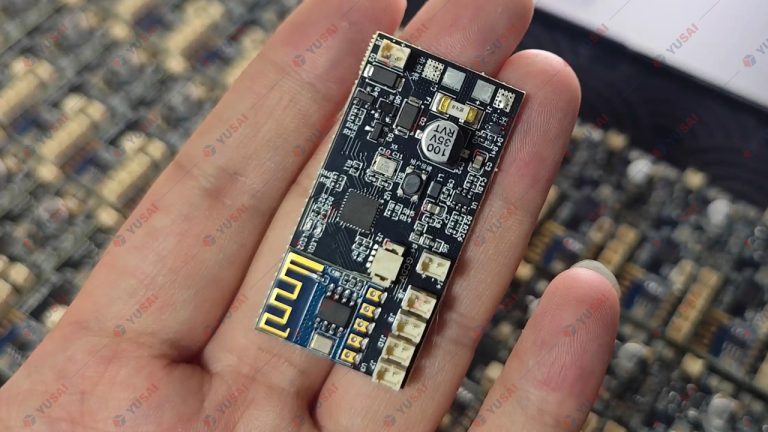
The core challenge of the dismantling stage is to “disassemble cleanly and separate thoroughly”: compressors, condensers, and evaporators from refrigerators and air conditioners correspond to iron, copper, and aluminum recovery; the gold coatings on board edge connectors and CPU pins require specialized equipment; hard disk platters are high-quality aluminum alloy; and wires and cables are split into copper cores and plastic insulation.
3. Stages Two and Three: Crushing and Sorting—The Main Battlefield of Mechanical Processing
After dismantling, the materials enter the crushing and sorting stages. This is the core of mechanical processing and a development hotspot in many countries. The principle is to exploit differences in physical properties—density, magnetism, electrical conductivity, and particle size—to separate metals, plastics, and glass:
- Crushing: whole machines or boards are crushed into small particles to facilitate subsequent sorting;
- Magnetic separation: removes ferromagnetic materials;
- Eddy-current separation: uses eddy currents to separate copper, aluminum, and other non-ferrous metals from plastics and glass;
- Air/gravity separation: sorts materials by density.
Mechanical processing offers low cost, simple operation, low risk of secondary pollution, and easy scaling—which is why it has become the mainstream pre-treatment approach in the industry. The sorted metal fractions are handed on to the metallurgical stage for extraction, while the non-metal fractions (plastics, fiberglass, etc.) enter reuse or harmless disposal.
4. Stage Four: Metallurgical Refining—Three Chemical and High-Temperature Routes
4.1 Chemical Processing (Hydrometallurgy)
Crushed particles are put into acidic or alkaline solutions for leaching, and the leach liquor then goes through extraction, precipitation, cementation, ion exchange, filtration, and distillation to yield high-purity metals. The advantages are high recovery rates and purity; the disadvantages are that strong acids and highly toxic fluorides are required, and large volumes of waste liquid and toxic off-gas are generated. If not handled properly, this can cause serious secondary pollution.
4.2 Pyrometallurgical Processing
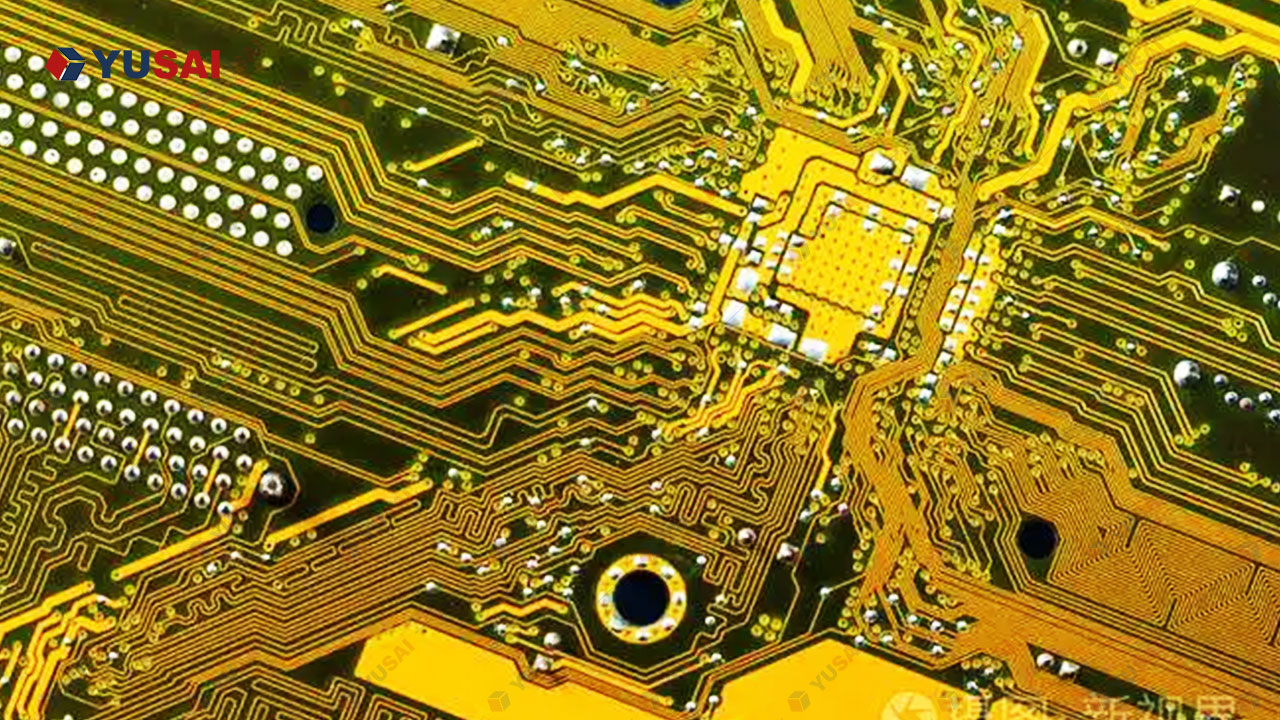
Through incineration, smelting, sintering, and melting, plastics and other organic components are removed and the metals are concentrated. It handles large volumes and is highly adaptable, but it also causes environmental damage—organic components release highly toxic substances such as dioxins when burned. The Guiyu area in Guangdong relied mainly on acid soaking and open-air burning in its early days, which seriously damaged the local environment; these are among the outdated processes explicitly banned by the state.
4.3 Microbial Processing (Bioleaching)
Studied since the 1980s, this technology uses microbial activity to oxidize the non-precious metals in precious-metal alloys into soluble compounds, exposing the precious metals for recovery. For example, studies using Acidithiobacillus ferrooxidans on pre-crushed waste circuit board fragments have leached more than 90% of the copper, zinc, and nickel under selected temperature, pH, and dosage conditions, with lead stabilized as lead sulfate in the residue. The advantages are simplicity, low cost, convenient operation, and environmental friendliness; the drawback is that leaching takes a long time, and the technology is currently used mainly for recovering precious metals from low-grade materials.
The choice among the three routes is essentially a trade-off between recovery rate, cost, and environmental cost. Modern large-scale processors typically use a combined process of “mechanical separation + hydrometallurgical/pyrometallurgical refining,” supported by complete off-gas and wastewater treatment systems.
5. Pollution Control Priorities for Each Process Step
Different processing methods produce very different pollutant profiles, and licensed processors must control them accordingly:
Dry treatment of cathode ray tubes mainly emits lead and dust, while wet treatment of the same tubes adds cadmium and nickel. Removing backlights from liquid crystal displays and wet separation of the liquid crystal both carry mercury risks, and separating panel glass from organic films produces dust, benzene-series compounds, phenols, and volatile halogenated hydrocarbons. Pyrometallurgical treatment of circuit boards releases dioxins, copper, lead, antimony, tin, benzene-series compounds, and phenols; hydrometallurgical treatment of boards generates acidic wastewater containing antimony, copper, lead, arsenic, chromium, beryllium, cadmium, and tin. Incinerating wires and cables emits dioxins, lead, benzene-series compounds, phenols, and volatile halogenated hydrocarbons. Handling nickel-cadmium batteries produces dust and cadmium; lead-acid battery processing releases lead and acidic waste; lithium battery processing produces acidic/alkaline waste; and capacitors containing PCBs release polychlorinated biphenyls.
This is precisely why the Regulations on the Administration of the Recovery and Disposal of Waste Electrical and Electronic Products require disposal enterprises to establish routine environmental monitoring systems and data information management systems (with basic records kept for no less than three years). Recycling technology is not only the technology of “extracting resources” but also the technology of “controlling pollution.”
6. Institutional Safeguards: Licensing, the Disposal Fund, and Producer Responsibility
Technology cannot take root without institutions. China’s institutional framework rests on three pillars:
- Licensing system: disposal enterprises must obtain qualification approval from the municipal-level ecological environment authority. They must have complete disposal facilities, a sound plan for treating or disposing of materials they cannot fully process, sorting and packaging equipment suited to the e-waste handled, and qualified technical staff in safety, quality, and environmental protection. Anyone disposing of e-waste without a license faces shutdown, confiscation of illegal gains, and fines of RMB 50,000 to 500,000. Those using state-banned technologies or processes may have their qualification suspended or revoked.
- Disposal fund system: producers of electrical and electronic products and consignees of imported products pay into the Waste Electrical and Electronic Products Disposal Fund, which subsidizes recovery and disposal costs—borrowing from foreign “producer responsibility” schemes to internalize end-of-life recycling costs into the production stage.
- Multi-channel collection plus centralized disposal: producers are encouraged to collect e-waste themselves or through sales outlets and repair services, and all collected e-waste must be centrally processed by licensed disposal enterprises. Sales, repair, and after-sales service outlets must display recovery and disposal information in a prominent position at their places of business.
From the Regulations (in force since 2011), to the Measures for the Administration of the Restriction of Hazardous Substances in Electrical and Electronic Products (2016), to the Green Manufacturing Engineering Implementation Guide promoting “whole-product dismantling and multi-component resource utilization,” the policy direction is clear: curb end-of-pipe pollution while restricting lead, mercury, cadmium, and hexavalent chromium at the source.
7. Technology Outlook
E-waste recycling technology is moving in three directions:
- Finer separation: upgrading toward automated and intelligent dismantling to raise component and material recovery rates;
- Green metallurgy: replacing strong acids and pyrometallurgy with bioleaching and low-toxicity leachants to reduce secondary pollution;
- Strategic element recovery: extracting rare earths such as neodymium, praseodymium, terbium, and dysprosium from e-waste—the U.S. Department of Defense’s 2025 investment in MP Materials, alongside efforts to push recyclers to extract rare earths from e-waste, marks e-waste’s entry into the strategic-resource agenda of major powers.
For practitioners, compliant, environmentally sound, high-recovery processing technology is both a legal requirement and the core of industrial competitiveness. E-waste processing is shifting from the “end of pollution” to the “front end of resources.”
Main references
- Baidu Baike entry “E-waste” , including data from the Global E-waste Monitor, the Guiyu environmental survey, and NEC/FAPS automated dismantling technologies
- Regulations on the Administration of the Recovery and Disposal of Waste Electrical and Electronic Products (State Council Order No. 551, in force January 1, 2011)
- Baidu Baike entry “Regulations on the Administration of the Recovery and Disposal of Waste Electrical and Electronic Products”